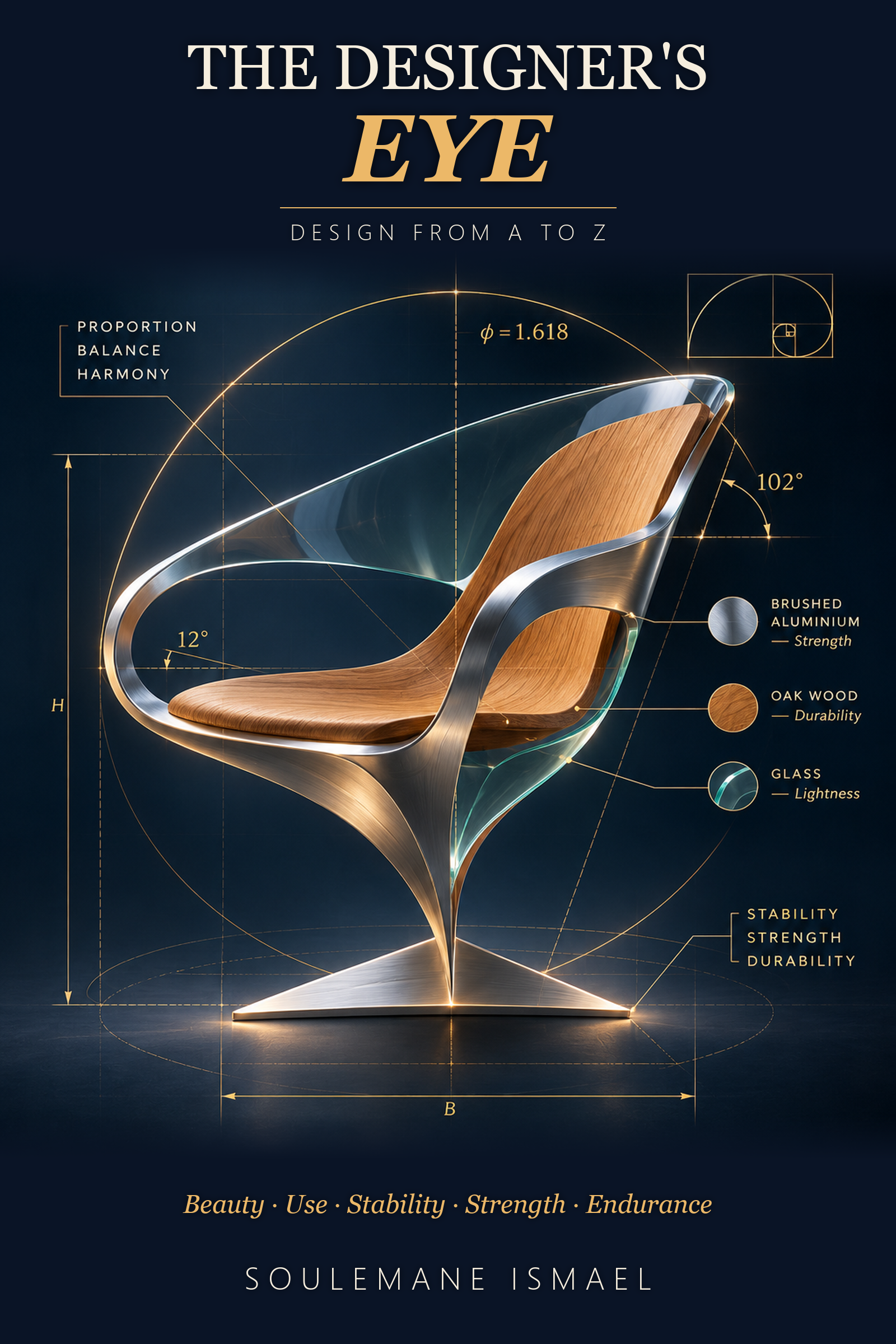

Learn to see, analyse and create the objects of the future.
“A great designer sees not only what is, but what should have been.”
The world is entering a new era. Tomorrow’s objects, screens, homes and clothes will not only have to be beautiful: they will have to stand firm, resist and last.
This book trains your eye. Chapter after chapter, you learn to look at any object, to analyse it with the 5-forces grid (beauty, use, stability, strength, endurance) and to imagine its best version.
What you will learn
- to look instead of simply seeing, and to analyse any object with an analysis sheet;
- to use the 5-forces grid: beauty, use, stability, strength, endurance;
- to speak the language of beauty: angles, proportions, balance, colour, light, materials, typography, simplicity;
- to understand what makes an object stand, resist and last: centre of gravity, loads, materials, wear, repair, testing;
- to design for people: the body, the hand, the eye, the user experience, accessibility, emotion;
- to know every field of design and the design of the future: new materials, nature as a model, artificial intelligence, the circular economy;
- to follow a complete method, from problem to object, and to progress with a 90-day plan.
Who is it for?
For complete beginners, students, craftspeople, entrepreneurs and people changing careers. No degree needed. Short sentences, and every technical word is explained the first time it appears.
What is inside
- 36 chapters in 7 parts, with a foreword and a conclusion;
- in every chapter: an everyday scene, a simple explanation, the 5-forces grid applied to the topic, a step-by-step method, a table of beginner mistakes, an eye-training exercise and the key points;
- an analysis sheet (chapter 5) and a 90-day plan (chapter 36);
- 328 pages in A5 format, as PDF and EPUB.
Learning to see is already the start of creating.
Contents
- Foreword
- Part I — Learning to see
- 1. The designer’s eye: looking instead of seeing
- 2. The 5 forces of a design: from Vitruvius to the future
- 3. Form and function: what the object must do before it is beautiful
- 4. Perception: how the brain reads a shape (Gestalt)
- 5. Analysing any object in 10 minutes: the analysis sheet
- Part II — The language of beauty
- 6. Attractive angles: viewpoint, perspective, line of force
- 7. Proportions and rhythm: the rule of thirds, modules, the golden ratio without the myth
- 8. Balance and symmetry: static, dynamic, tension
- 9. Colour: psychology, harmonies, contrast, culture
- 10. Light and shadow: what gives volume and emotion
- 11. Materials and textures: touch can be seen
- 12. Typography and signs: design that speaks
- 13. Simplicity: taking away down to the essential
- Part III — Stability, strength, endurance
- 14. Stability: centre of gravity, supports, base
- 15. Strength: loads, triangles, bending, weak points
- 16. Materials: wood, metal, plastic, glass, textile, leather, composites
- 17. Endurance: fatigue, wear, ageing well
- 18. Repair, disassemble, recycle: design that lasts
- 19. Testing like a great designer: prototypes, trials, useful failures
- Part IV — Design in the service of people
- 20. Ergonomics: the body, the hand, the eye
- 21. User experience: affordances, signifiers, feedback
- 22. Design for all: accessibility and universal design
- 23. Emotion and attachment: why we keep certain objects
- Part V — All the fields of design
- 24. Product and industrial design
- 25. Graphic design, visual identity and the logo
- 26. Digital design: interfaces, screens, apps
- 27. Architecture and interior design: space
- 28. Fashion and textiles: the garment as a structure
- 29. Packaging and presentation: the first contact
- 30. Service and experience design: drawing a journey
- Part VI — The design of the future
- 31. Smart materials and new manufacturing
- 32. Nature as a model: biomimicry
- 33. Artificial intelligence: the designer’s tool, not their replacement
- 34. Sustainable and circular: design’s new dilemma
- Part VII — Becoming a great designer
- 35. The complete method: from problem to object
- 36. The path of the great designer
- Conclusion
What you receive
- The book as PDF (328 pages, A5) and EPUB.
The files are downloaded from your account and are yours to keep.
Author: Soulemane Ismael. Publisher: QuadroSysteme. First edition, 2026. Translated from the French. Cover: generated image.










Avis
Il n’y a pas encore d’avis.